Posts

Bond yield to maturity

  Yield To Maturity  is one of the important measures of Bond investment. It shows the expected annualized return at the current market price of a bond.   When fixed coupon bond trade in market , its prices vary according to demand and supply. As price changes the rate of return or yield will vary. Price - Yield to maturity (YTM) relationship is given by the following formula   P = c1/(1+y) + c2/(1+y)^2 +....+cn/(1+y)^n + f/(1+y)^n   P is price at any point of time C1,C2...Cn are coupon payments each year. For fixed coupon bonds C1=C2=...Cn f = face value of the bond y= Yield to maturity at any point of time before maturity   From this equation we can easily say Bond Price and yield has inverse relationship. Bond prices will inversely vary with prevailing interest rate also. Say, a bond is issued at 8% yield in 2015. Now if the interest rate goes up by a percent in market, as coupon is constant, P needs to go down to give 9% yield.   Sometimes the yiel...
Different uses of Bonds

  Bonds as a mode of financing   When a company needs to expand its business, there are three ways to fund the expansion 1) Debt 2) Equity 3) Retained profits also known as Internal accruals .   Similarly Govt expenditures can be funded primarily in 3 ways. 1)Debt 2) Tax 3) Expanding monetary base (loosely printing money, you should have heard in business channels. Not applicable for countries like Greece. Why?)   For both corporates and Govt bond act as an important debt instrument for financing.   Bond as a collateral   Bonds with good credit rating can be used as collateral to borrow money in Repos. Repos and reverse repos are short term money market instrument .Central banks use Repos and Reverse repos in the financial market to keep the short term interest rates within its target range. Govt bonds is one of the important collaterals for such transactions. For example , if a bank has 100 million dollar Govt bonds , they can pledge bonds and can borrow ...

Austrian School

  Austrian school is one of the economic schools of thought that focuses on individualism and the free markets. Many economists from Austria initially contributed to this in early 20th century. Noted economists were Hayek,  Mises etc. It lost much of its relevance post 'Keynesian Revolution'. Austrian school economists developed Austrian Business Cycle Theory (ABCT) . It says boom in the economy happens due to low interest rates. Low interest rates by banks induce individuals and companies to do investments which are not viable earlier. This will increase employment in the short term. Boom and expansion will sustain as long as low interest rate prevails. But the credit driven boom cannot go on forever and eventually resulting in a bust/recession. On 'the day of reckoning', when interest rates rise, many of the investments will turn bad. The recession is to correct the malinvestments. Some Austrians viewed Fractional Reserve Banking system kept the interest rates low and...

Milton Friedman and monetarism

  Keynesian solution of ,Government playing God to rescue people from crisis was loved by politicians. Free market proponents were not encouraged. Starting 1950s, the fightback to Keynesian school was spearheaded by Milton Friedman . He argued by tuning the money supply in the economy you can have stable system, rather than Government intervention which is known as Monetarism.   Inflation is a monetary(money) phenomenon everywhere ,he declared. He cited an example, of American civil war, where inflation in the south was 4% a month . One fine day, the Northern army ran over the money printing press of the south . It took 2 weeks to relocate the money printing press and start printing again. In 2 weeks , inflation came to a halt in the south. Sustained inflation has only one cause,  money supply outpaced the production of goods and services. He argued for increasing money supply at constant rate for stable economy.   Milton Friedman was an anti-Government crusader. 'Th...

Keynesian Response to Economic Slowdown

  After 1929 , US witnessed lot of slump in the economic activity, resulting in many bankruptcies and layoffs. According to classical economy , market plays God. What it means is, whenever there is a fall in demand , price will fall and because of price fall,  demand needs to pickup. So every product that's getting created , will be sold at some price. For example, say suddenly people buy only Android phones. Apple needs to cuts its prices down. At some price, people needs to start buying iPhones again . Similarly if someone is unemployed in a recession , he is part of labour supply. If he cuts his salary expectation he will become employed at some point of time and start producing goods/services.   During the depression, people waited for prices to find a bottom and economic activity to pick up. Unemployment peaked at 25% and didn't come down significantly until spending on second war started.   Spending decision of persons/Govt, will have multiplier impact in overa...

Emergence of Keynesian Economics

  Let’s see about different schools of economic thought…   Queen Victoria of England was known as Grandmother of Europe. Her family had marriage relationships with other European countries' Monarchs. Queen Victoria , Kaiser Wilhelm of Germany and Tsar Nicholas II of Russia were  relatives . But that couldn't prevent them fighting the World War I, and causing a massive destruction.   After WW-I , the late entrant in the war, USA emerged economically stronger. In the post-war period, what is known as roaring twenties, Ford implemented the Assembly line mechanism to improve productivity and to cut the price of his cars. In this ,workers made to do single type of work and products move from one stage to another along the assembly line. (Charlie Chaplin made fun of this in  Modern Times  ) The increased productivity pushed prices down and many were buying cars ; roads had to be built for cars, which created a lot of well-connected suburb...

Efficient Market Hypothesis

Image
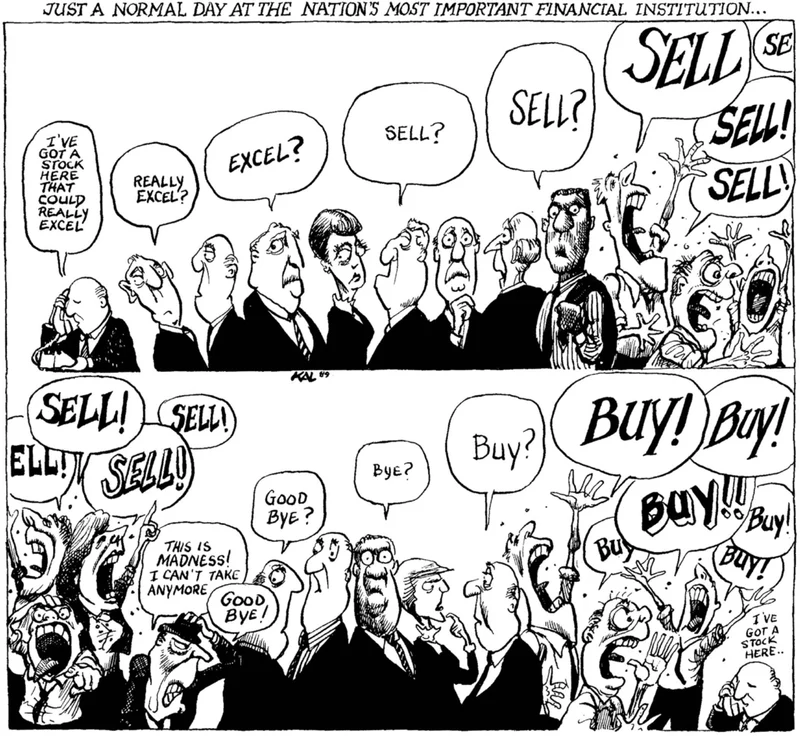
  Fundamental analysts analyse the intrinsic value of a company by studying various parameters like price to book, return on assets, its performance growth over few year, its liabilities, expected cash flows etc. Technical analysts on the other hand, reads stock patterns and predict future stock prices. They don’t need to know anything more , except the chart. They don’t even need to know the name of the  company whose chart they are analysing. Sometimes both analysis may work in opposite direction. When prices rise rapidly , it may signal a technical uptrend and hence a buy. But fundamental analysis will show stock prices getting costly. Similarly on a heavy selloff , technical analysis will indicate a sell while fundamental analysis will recommend the opposite.   One Economic professor ,who was a proponent of Efficient Market Hypothesis ,asked his students to draw patterns by tossing coins. The students threw coins a number of times and drew the charts (1/2% up if head ...